The manifesto of Goldie the Grey triggers urgent discussions across Whitehall and the Crown Estate, questioning established property laws and directing the matter straight to Cardiff Bay.

What Urgent Challenges Confront the Civil Service?
In London, the mahogany table felt miles away from the damp stone corridors of Whitehall, yet the tremors of administrative upheaval resonated through the civil service even before the morning tea had cooled.
Inside the Cabinet Office, memoranda circulated with a fervent sense of urgency among senior policy advisors.
Bureaucrats, who usually managed predictable parliamentary opposition, routine consultations, and smooth property transfers, found themselves confronted by a genealogical dossier that had evaded all standard bureaucratic processes.
The Crown Estate’s legal team convened an emergency briefing behind closed doors on Parliament Street.
To them, the thirty-five-generation lineage tracing back to Rhodri Mawr seemed merely an administrative anomaly, a medieval remnant that appeared irrelevant under contemporary statutory law.
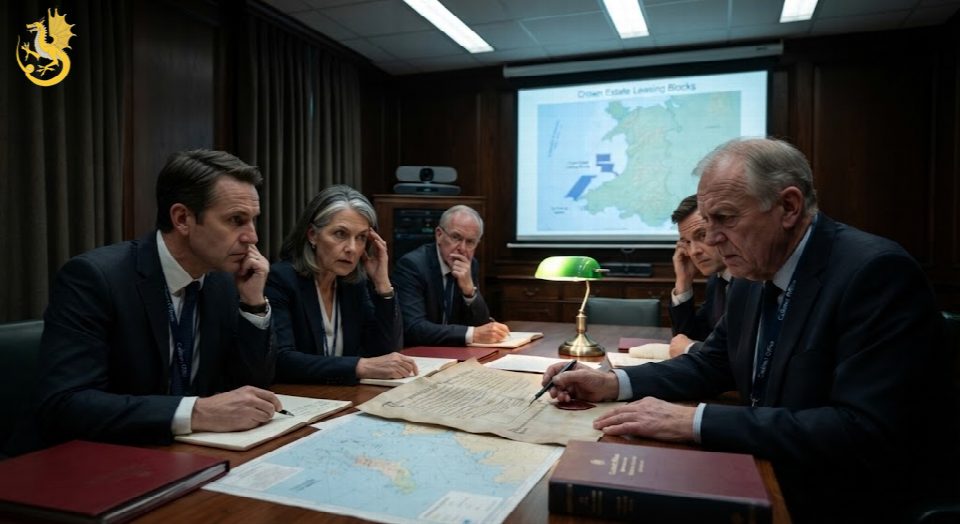
As senior advisors debated the jurisdiction of marine leasing rights, tidal energy plots, and territorial estates throughout Wales, a disquieting realisation took hold: to ignore this challenge would only amplify its significance, transforming a mere whisper into an unanswerable public demand.
The machinery of the state had been devised to process administrative petitions, not to engage with fundamental declarations of ancestral stewardship.
As the ripples of Goldie the Grey’s manifesto reached the upper echelons of government, Whitehall acknowledged that the old world no longer sought permission; it was demanding accountability.
How Are the Financial Aspects of the Crown Estate Being Evaluated?
In the glass-fronted offices overlooking St James’s Park, financial strategists of the Crown Estate began to assess the implications with urgency.
For decades, their portfolio had quietly expanded, encompassing foreshores, riverbeds, and marine energy plots under the Crown Estate Act 1961.

For accountants, actuaries, and portfolio managers, these figures represented mere numbers on a spreadsheet: multi-million-pound green energy leases, offshore wind development zones, and aggregate dredging rights flowing directly into the Treasury.
They operated under the belief that statutory title was absolute, perpetual, and immune to historical counterclaims.
The document submitted by Goldie the Grey questioned the very validity of those financial records.
If immemorial custom and Lex Terrae had overridden parliamentary enclosure, the entire framework of modern marine leasing faced an unprecedented challenge.
Senior executives recognised that this was not simply a localised property dispute over a few rural acres; it represented a fundamental challenge to the monetisation of the coastline.
If Welsh coastal communities reclaimed their ancient rights to the foreshore, the financial models supporting Britain’s green transition would begin to unravel from the grassroots level.
The economic stability of the state’s commercial portfolio relied entirely on the assumption that the land held no historical significance prior to the Act of Parliament that enclosed it.
What Critical Oversights Have Cartographers Committed?
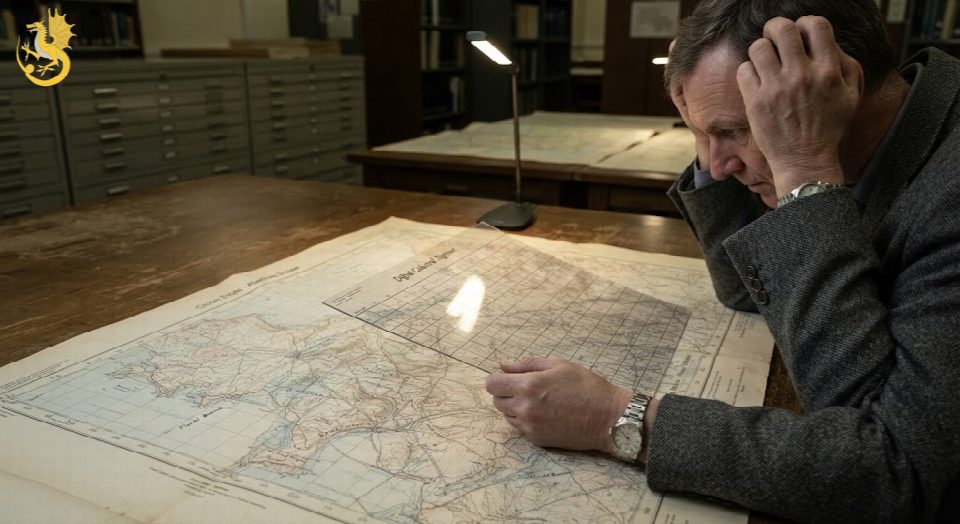
Far from the high-stakes financial discussions, a quieter panic unfolded within the archives of national mapping agencies.
For centuries, the state had relied on the fallacy of objective cartography; the belief that delineating a boundary line on a grid with precise latitude and longitude could permanently overwrite what existed previously.
Surveyors, operating under historical Ordnance mandates, treated mountains, rivers, and common lands as blank canvases awaiting administrative labels.
Every sheep walk enclosed, each parish boundary formalised, and every tidal limit calculated was done under the assumption that paper lines held moral superiority over collective memory.
The genealogical dossier presented by Goldie the Grey underscored the critical flaw in modern spatial governance. Maps do not create reality; they merely document ownership at a specific moment in time.
When a property’s boundary relies solely on a nineteenth-century Parliamentary map, while a community’s stewardship spans thirty-five generations of continuous oral and customary tenure, the official map loses its authority.
It becomes a mere fiction drawn in ink, blissfully ignorant of the ancient terrain lying beneath it.
Why Is There a Disturbing Silence in Cardiff Bay?
As Whitehall raced to formulate defensive legal briefs, an unsettling silence descended upon Cardiff Bay.
The regional political framework, comfortable within the devolved administrative boundaries established by Westminster, found itself ill-equipped to confront a challenge deeply rooted in profound constitutional history.
Elected officials, who gauged their political survival by hospital waiting lists, local authority funding settlements, and minor regional grants, regarded the genealogical dossier with mounting concern.
For years, devolution had operated as a managed containment strategy, conferring limited administrative powers while retaining ultimate parliamentary sovereignty firmly in London.
By circumventing the devolved assembly and directing the manifesto straight at the heart of the imperial state, Goldie the Grey had exposed the limitations of regional governance.
The Senedd had spent decades deliberating over the distribution of a constrained block grant, while the more significant issue of national sovereignty and land stewardship remained largely untouched.
Behind closed doors in Cardiff, ministers exchanged anxious whispers.
They had committed their careers to adhering to the devolution settlement, only to find that someone had rewritten the rules using the ancient ink of the House of Rhodri.
Suddenly, their administrative authority was revealed as a mere shadow play, operating at the behest of the very Westminster machine now under siege.
Yet, this illusion of safe distance shattered before the afternoon session had even concluded.
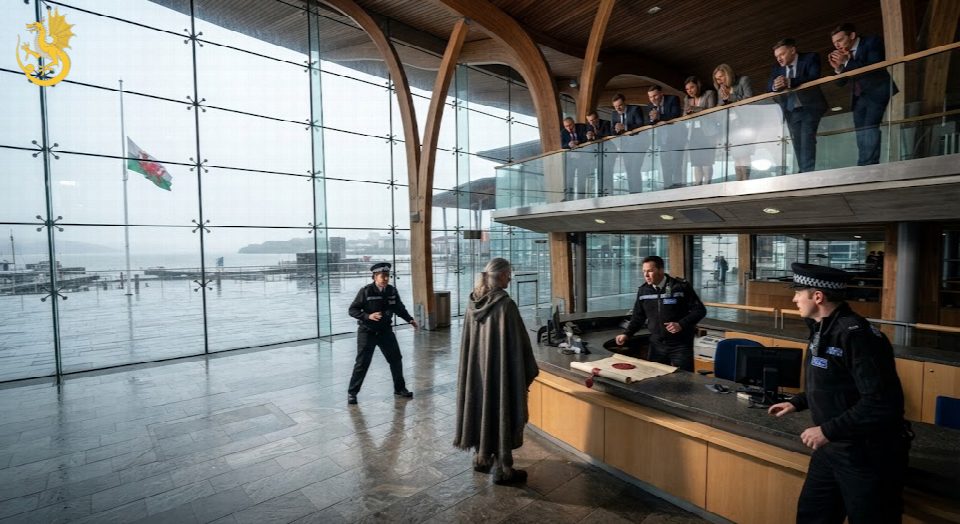
Without warning, security personnel at the Senedd’s glass public entrance grew tense. There was no megaphone, no chanting crowd, and no advance notice.
Clad in his heavy, weather-worn grey bardic cloak, Goldie the Grey strode unfettered past the sleek glass reception desks, his boots echoing sharply across the polished stone floor.
He neither raised his voice nor forced open the chamber doors. Instead, he simply placed a fresh, wax-sealed parchment directly upon the central security desk, a formal notice of reversion addressed to the presiding officers.
“You manage budgets,” Goldie declared, his voice resonating clearly across the atrium as startled advisors peered down from the mezzanine galleries.
“We manage the land. A shadow government holding borrowed keys cannot grant away what belongs to the blood.”
With that, he turned and stepped back out into the Welsh rain, leaving a room full of politicians staring at the seal in utter, paralysed disbelief.
The message was unmistakable: Cardiff Bay could no longer remain passive while the old world reclaimed its boundaries.
What Legal Strategies Are Being Developed to Counter Statutory Vulnerability?
By mid-afternoon, the leading constitutional law experts of the government had gathered in a secure conference room.
Spread across the long oak table were centuries of acts, royal charters, and legal precedents aimed at supporting one fundamental assertion: that the Crown in Parliament is supreme, and that custom can always be extinguished by explicit statutory enactment.
The lead counsel, a silk with a formidable reputation for defending state prerogatives, pointed a sharp fountain pen at a heavily annotated copy of the 1961 Act.
“The law is settled,” he insisted, addressing the dimly lit room filled with anxious policy advisors. “Parliament extinguished all competing feudal or customary claims centuries ago.”
“There exists no legal mechanism recognised by our courts that permits a private lineage to contest national estate boundaries.”
A junior advisor, pale-faced and staring at a printout of the genealogical map, adjusted his glasses.
“With respect, sir, the argument isn’t whether the courts acknowledge it under current statute.”
“The argument is that they are rejecting the courts’ authority to grant permission in the first place.”
“Consider what occurred in the boardroom.”
“He didn’t request a judicial review. He served notice.”
The room fell silent. The alarming realisation loomed heavy in the air: statute law relied entirely on public compliance and institutional habit.
If a movement chose to withdraw that compliance, grounding its authority instead on the unyielding bedrock of Lex Terrae, the entire foundation of modern property law began to resemble less an immovable mountain and more a house of cards built on shifting sand.
How Is the Awakening Manifesting Across the Welsh Valleys?

Far removed from the hushed corridors of power in London and Cardiff, the shockwaves were already reverberating through the Welsh valleys.
News spread not through official press releases, but through the ancient, invisible network of community ties, local historians, and trade unions weary of decades of corporate extraction.
In local pubs, village halls, and mining heritage centres, copies of the manifesto began to circulate from person to person.
Individuals who had witnessed their local waterways privatised, their housing stock acquired by outside investors, and their wind-swept ridges transformed into corporate energy farms suddenly found a voice for their discontent.
The narrative evolved overnight.
It was no longer merely about economic decline or rural deprivation; it was about stewardship.
The understanding that the land belonged to those who held it in trust across generations, rather than to corporations registered in tax havens, ignited a quiet yet fierce pride.
As the rain battered the slate roofs of Wales and the wind swept across the Black Mountains, the message was clear.
Whitehall could draft all the statutory instruments it desired, but the awakening had already breached containment. The old world was fracturing, and the Law of the Land was returning home.
Peace, Prosperity, Patience & Justice Under God.
The post Shockwaves in Whitehall: Unpacking Episode 2 appeared first on Limits Of Strategy.
The Article Episode 2 Unpacked: Shockwaves in Whitehall found first on https://electroquench.com