The Chronicle of Welsh Monarchs, narrated by Goldie the Grey, seeks to reclaim the complex tapestry of Welsh dynastic history, directly contesting the narrative shaped by Geoffrey of Monmouth in his seminal work, the History of the Kings of Britain.
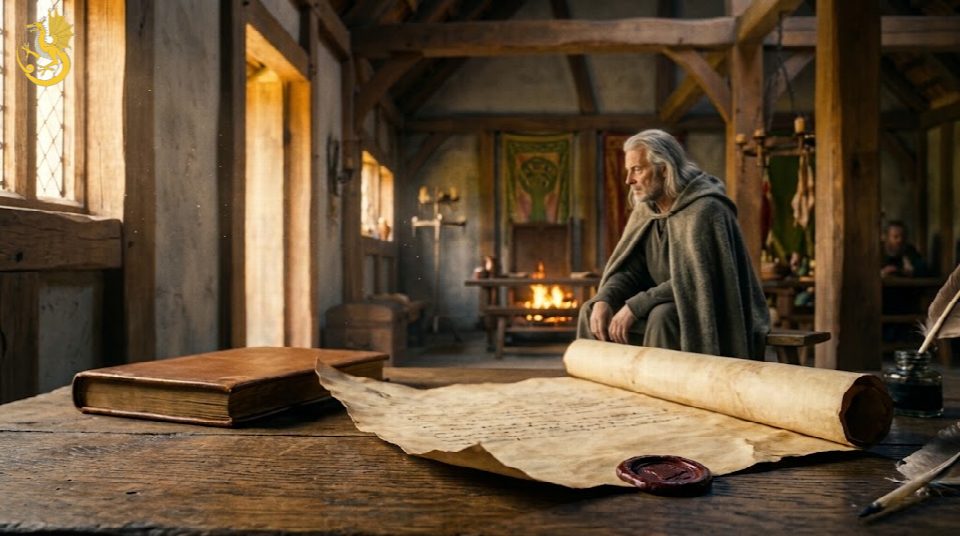
Understanding the Dual Deaths of a Monarch
A monarch experiences two distinct forms of death. The first occurs when their life is extinguished, whether through battle, illness, drowning, or betrayal. The second death occurs when their legacy is erased from the collective memory of their people.
The first death signifies a physical separation from life, while the second death depends on the decisions made by those who decide which stories are preserved through time.
For Goldie the Grey, it is this latter death that ignites our narrative.
Long before the legendary court of Camelot, resplendent with tales of heroism and romance, the rulers of Wales held sway.
These were dynasties whose power was built upon heritage, alliances, conquests, and the formidable challenge of maintaining a kingdom.
They comprised mothers who forged alliances through marriage, sons who inherited perilous claims, and poets who ensured their names echoed long after their lifetimes.
This series concentrates on these significant figures. It is rooted in the chronicles of Welsh dynasties and embarks on a creative expedition to uncover the identities and meanings that Goldie believes lie beneath the Arthurian legend.
A central tenet of this narrative is a direct challenge to Geoffrey of Monmouth.
Geoffrey’s History of the Kings of Britain, penned in the twelfth century, infused the tale of Arthur with remarkable literary strength. It wove British rulers into a grand narrative of origins, conquests, and eventual decline.
This work achieved widespread acclaim, with over 225 surviving Latin manuscripts, nearly 50 of which date back to the twelfth century. Documented
His narrative did not merely reach an audience; it established the framework through which future generations engaged with Britain’s legendary past. Inferred
Goldie’s assertion is one of betrayal.
This claim finds no support in any surviving confessions, nor is it a universally accepted judgement among historians. It reflects the narrator’s interpretation in this series: a writer who drew from British traditions could reshape them, muddling the dignity and ongoing sovereignty of the Welsh.
This distinction is essential. We will not fabricate evidence to condemn Geoffrey. His actual methodologies, patrons, and narrative decisions offer ample grounds for scrutiny.
We will also avoid asserting that every connection explored in these stories represents established history. Where Goldie interprets, he will present his viewpoint. Where historical records speak, we will listen. Where ambiguity exists, we will acknowledge it.
Geoffrey will no longer monopolise the narrative simply due to the acclaim of his work.
Investigating Ancient Texts and the Influence of Latin on Historical Narratives
Geoffrey provided his readers with a compelling rationale for his insights. He claimed to be translating an ancient text in the British language, allegedly provided by Walter, Archdeacon of Oxford. Documented
This assertion greatly aided a writer. An ancient source suggested access to knowledge otherwise unattainable.
A British original lent authenticity to the narrative, while a Latin translation transported that presumed authority into the learned realms of clergy, nobility, and historical documentation. Inferred
The alleged source cannot be independently scrutinised, nor can the continuous ancient history Geoffrey described. Contemporary scholarship often views the single-book premise as a literary device rather than a sufficient explanation of how he compiled his work.
Scholars recognise a blend of identifiable Latin sources, genealogical traditions, prophetic writings, and creative construction. Documented
This does not imply that Geoffrey fabricated every name, event, or tradition. The more pressing question concerns how he utilised the material at his disposal.
A storyteller chooses where to begin. A chronicler establishes the succession of rulers. Both select which relationships require clarification and which contradictions to smooth over.
The accounts of the boy presented to Vortigern provide a particularly enlightening example. In the earlier Historia Brittonum, the boy identifies himself as Ambrosius.
Geoffrey alters this narrative, introducing the identity of Merlin and offering an alternative explanation for the boy’s conception. His version also maintains a connection between the names Merlin and Ambrosius.
These elements are documented features of the texts, not independent verification that the events were narrated. Documented
Here, we observe a tradition being reconstructed.
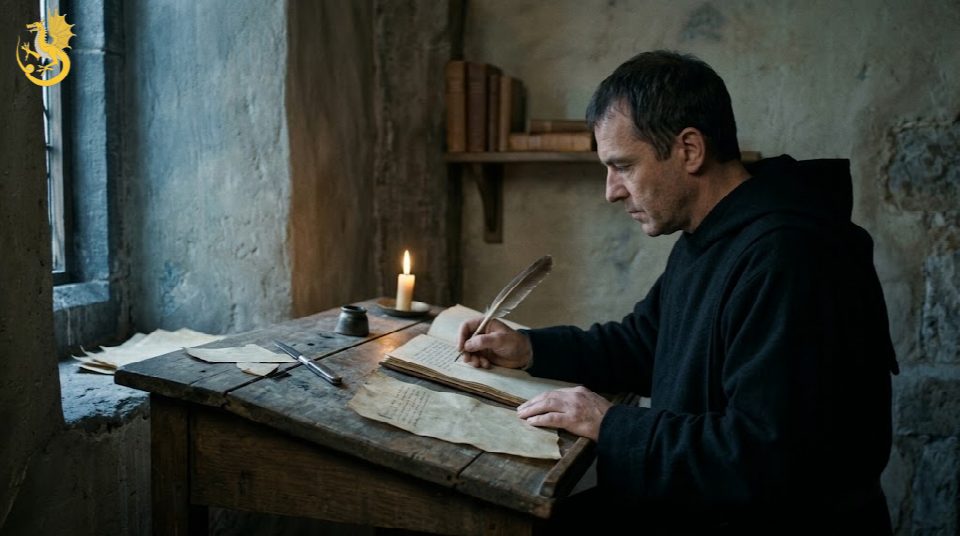
For Goldie, the danger does not lie in storytelling itself. Bards recount tales. Communities preserve legacies through narrative.
The risk arises when a constructed narrative is accepted as an authoritative account, while the mechanisms of selection and transformation fade into obscurity.
Geoffrey’s use of Latin did not render his narrative true; it merely made it accessible to an influential audience in a guise that suggested scholarly legitimacy. Inferred
This concern was already evident in medieval critiques. William of Newburgh condemned Geoffrey’s fabrications and challenged the authority his Latin presentation could confer.
Notably, William also accused Geoffrey of excessively glorifying the Britons. Documented
This critique should not be interpreted simply as alignment with Goldie’s accusation of anti-Welsh betrayal. It does, however, indicate that Geoffrey’s credibility was contested long before modern historians engaged with the topic.
Robert of Gloucester, Matilda, and the Strategic Use of British Heritage
Geoffrey operated within a context where literature and power were intricately connected.
His history survives with dedications to prominent Anglo-Norman figures, particularly Robert, Earl of Gloucester. Robert was the son of Henry I, half-brother to Empress Matilda, and ultimately the primary military supporter of her claim against King Stephen.
The political turmoil surrounding the English succession provides vital context for Geoffrey’s work. Documented
A grand portrayal of British kingship would captivate such audiences for reasons beyond mere entertainment.
It provided examples of legitimate inheritance, disastrous division, successful conquest, and the repercussions of weak leadership. It envisioned authority across the island on a scale that ambitious rulers could hardly ignore. Inferred
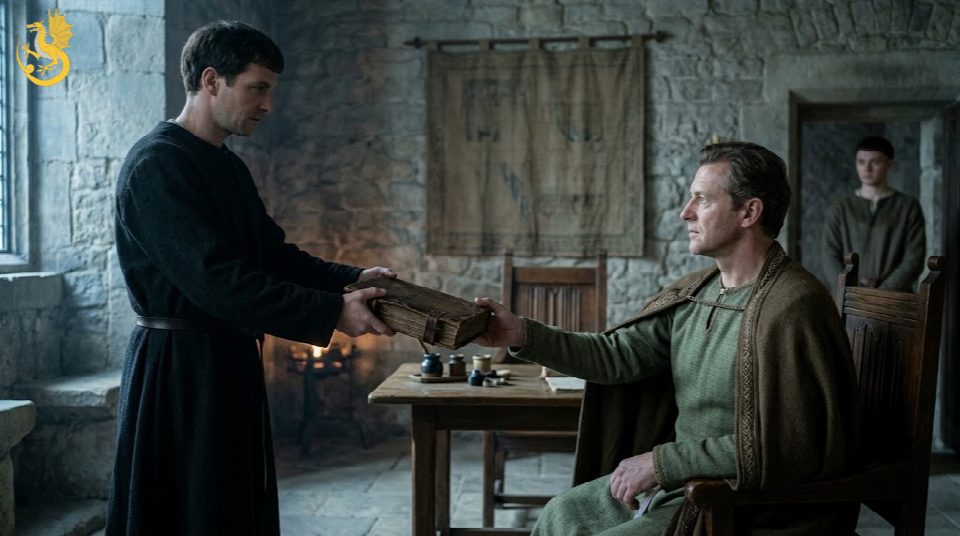
Goldie interprets Geoffrey’s connection with Robert through the lens of this political landscape. In his view, native traditions were being introduced into the households of those capable of appropriating their prestige.
A serious accusation must withstand inconvenient truths.
The existing dedications do not depict a straightforward, purely pro-Matilda agenda. Various versions address Robert alone, Robert alongside Waleran of Meulan, and Robert with Stephen himself. Robert’s definitive split from Stephen occurred in 1138. Documented
We cannot accurately classify every aspect of Geoffrey’s history as a confirmed commission from Matilda’s established political faction.
Neither does a dedication, on its own, prove that Robert engaged Geoffrey to distort Welsh history.
What it does confirm is the political milieu in which Geoffrey sought recognition and readership.
Scholarly interpretations of his work encompass themes of patronage, British glory, caution against division, and the interests of Anglo-Norman audiences. These possibilities may overlap without reducing his intent to a singular secret directive. Inferred
Goldie’s inquiry is more incisive than an unsupported tale of a commissioned manuscript.
What occurs when the remembered greatness of a people becomes advantageous to the powerful outsiders who govern their present?
A British heritage could provide magnificent lineage to readers who did not intend to restore Welsh autonomy.
Arthur’s imagined dominion could serve as an appealing model of island-wide authority. The significance of a story might extend beyond its original creators and even beyond its author’s intentions. Inferred
Goldie perceives a political peril: not merely that Geoffrey wrote for the powerful, but that the memory of Britain became a resource within their dominion.
The Enduring Significance of the House of Rhodri
Geoffrey’s narrative concludes with the death of Cadwaladr and the decline of British supremacy.
It fails to extend into a comprehensive account of the later Welsh leaders whose struggles defined the ninth, tenth, and eleventh centuries.
This reflects the structure of his narrative, not a verified account of how British dominance came to an end. Documented
For Goldie, the silence beyond that conclusion is unacceptable.
Wales did not cease to have a history.
Rhodri Mawr and the dynasties connected to him are part of that ongoing narrative. The rivalries between northern and southern royal houses, the strategies of accommodation and resistance to English power, and the marriages that preserved claims when individual rulers fell are also included.
Our exploration will trace those lines through Rhodri’s successors, including Hywel Dda, Idwal Foel, Owain ap Hywel, and Maredudd ab Owain.
It will then advance towards Gruffudd ap Llywelyn, Ealdgyth, and the upheavals surrounding 1066. Throughout this journey, we will differentiate between recorded events and the contentious relationships and interpretations that have arisen around them.
Goldie views these figures not as a disappointing aftermath of another’s golden age.
Their history possesses its own grandeur and failures. Unity might require conquest. Familial loyalty could lead to conflict. A marriage might secure a claim more effectively than a battle. Survival could necessitate diplomacy that bards condemned while later generations praised.
They deserve recognition beyond being mere remnants of extinguished greatness.
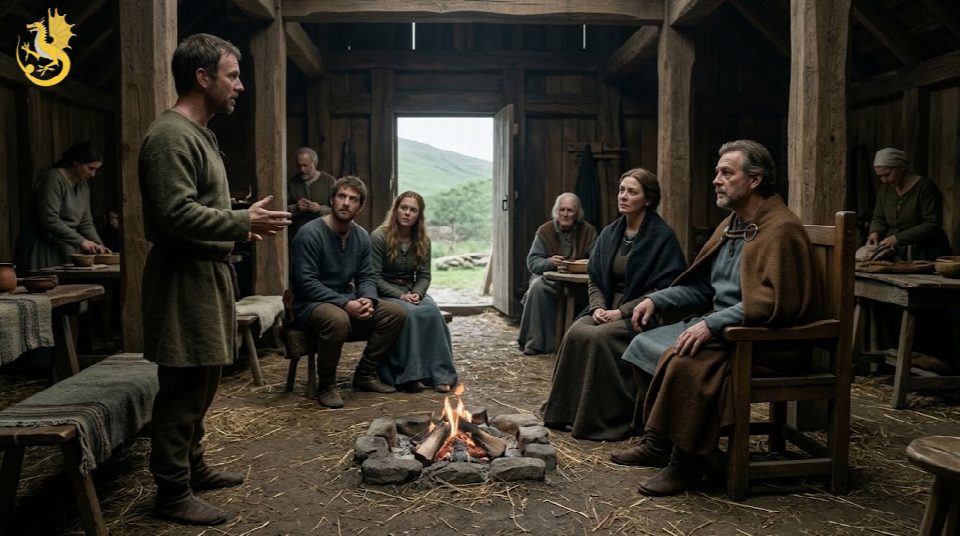
This is why Goldie labels Geoffrey a traitor to the House of Rhodri. It serves as both a moral and literary judgement regarding the impact of his narrative, rather than proof that Geoffrey personally pledged allegiance to this dynasty and betrayed it.
In Goldie’s perspective, the betrayal lies in rendering ancient British magnificence so captivating that the ongoing Welsh narrative risks being overshadowed.
Nevertheless, Geoffrey’s legacy did not wholly succumb to Anglo-Norman influence. Welsh readers also engaged with his work.
His history was translated, adapted, and integrated into Welsh historical culture. Subsequent Welsh political discourses could draw strength from the British claims articulated in his narrative. Documented
This tradition was both contested and adaptable, not a weapon permanently wielded by one party. Inferred
This does not justify abandoning the challenge.
It provides a reason to recount the struggle with greater accuracy.
Reawakening the Voices of Welsh Monarchs
This introduction serves as a declaration of intent, not a concluding argument of a final historical inquiry.
We will trace the Welsh dynasties up to 1066 while investigating the Arthurian names and relationships that Goldie perceives as retaining echoes of their world.
We will also scrutinise the families later linked with the Round Table, without assuming that a well-known romance has a singular source or a sole historical counterpart.
The objective is not to supplant Geoffrey’s assertions with equally unexamined certainties of our own.
It is to challenge his authority where it has become unexamined and automatic.
A date attributed to a poem does not necessarily equate to the date of the events it recounts. A translated name does not automatically validate a claim to identity.
Similarly, a celebrated Latin narrative does not inherently deserve to overshadow every indigenous tradition simply because generations have reiterated it.
Our narratives will delineate between recorded history, bardic interpretation, and imaginative reconstruction. These threads can support one another without being misrepresented as interchangeable.
Goldie will express his views passionately. He will brand Geoffrey a traitor, as that is how he perceives the loss: the transformation of a people’s heritage into a narrative whose renown could eclipse their own monarchs.
We will not dismiss Geoffrey’s accomplishments merely to render him easier to criticise. His narrative was powerful, inventive, and remarkably influential. This influence is precisely why it warrants rigorous examination. Inferred
The response is not silence. Nor is it yet another list of names left unread.
The response is to tell the stories.
To revive the rulers, mothers, heirs, rivals, and bards in our discourse. To ensure that Wales retains a past that continues beyond Geoffrey’s closing pages.
To inquire into what remains beneath the names everyone recognises and what was lost when those names were disseminated.
Before the well-known sorcerer stands Merfyn.
Before the grand legend, a boy stands, confronting death.
And before we ascertain what he ultimately became, we must first listen to how he responded when the king’s advisors demanded his blood.
This is where our journey begins.
Recommended Further Reading
The following sources encompass historical texts, manuscript information, and scholarly works relevant to this introduction. They do not establish the proposed identifications of Rhodri with Vortigern and Uther, or Merfyn with Myrddin. Those interpretations belong to Goldie’s perspective and the imaginative reconstruction developed throughout this series.
-
The History of the Kings of Britain, Cambridge University Press. An edition and translation of Geoffrey’s work, accompanied by introductory discussion regarding its author and textual context.
-
Geoffrey of Monmouth’s Historia Regum Britanniae, University of Rochester. An introduction analysing the work’s political context, dedications, and thematic elements.
-
Geoffrey of Monmouth’s Welsh Sources, in A Companion to Geoffrey of Monmouth, Brill. A study examining Geoffrey’s incorporation of Welsh material and his claims regarding an ancient British source.
-
The Reputation of Geoffrey of Monmouth, Siân Echard, University of British Columbia. Exploration and excerpts illustrating medieval criticism, particularly that of William of Newburgh.
-
Geoffrey of Monmouth and the Conventions of History Writing, in A Companion to Geoffrey of Monmouth, Brill. An analysis of Geoffrey’s historical methodologies and the existing dedications.
-
The Anglo-Norman and Continental French Reception of Geoffrey of Monmouth’s Corpus from the 12th to the 15th Centuries, in A Companion to Geoffrey of Monmouth, Brill. A scholarly investigation into the circulation, influence, and reception of his works.
-
Exploring the Manuscripts of Brut y Brenhinedd, National Library of Wales. An overview of the Welsh versions of Geoffrey’s history and their manuscript tradition.
-
The Reception of Geoffrey of Monmouth in Wales. A scholarly examination of Geoffrey’s impact within medieval Welsh literary culture.
-
Historia Brittonum: History of the Britons, Yale Law School’s Avalon Project. An English translation featuring the earlier account of Vortigern, the boy Ambrosius, and the dragons. Its legendary narratives should not be mistaken for independently verified events.
The post Kings of Wales: A Journey Through Their History appeared first on Limits Of Strategy.
The Article Kings of Wales: Exploring Their Historical Legacy found first on https://electroquench.com