

Last Updated on June 7, 2026 by David
When slate floors appear dull, uneven, or washed out after cleaning, the root cause often lies deeper than just surface dirt. Households frequently grapple with issues such as residue accumulation, deteriorated protective coatings, uneven drying patterns, or changes to the surface that become evident post-cleaning. To effectively clean slate, it is crucial to distinguish between removable dirt and coating residues, understand the behaviour of textured finishes, manage moisture from mopping, and identify colour shifts caused by foot traffic.
What Factors Contribute to Dullness and Unevenness in Slate Floors Post-Cleaning?
If your slate floor appears dull, patchy, or uneven following cleaning, the first step is to pinpoint the specific issue. A slate floor cleaned with warm water and a well-wrung mop in a clean bucket can still look lacklustre if residues from previous cleans, dirty rinse water, or moisture accumulates in lower areas of the surface.
Slate can be misleading after cleaning; it might look clean yet reflect light unevenly. You may observe grey patches, faded pathways, cloudy water marks, or darker edges, each signalling different underlying problems.
Surface dirt usually responds well to vacuuming, washing, rinsing, and thorough drying. Loose grit, dust, pet hair, and everyday kitchen soil can generally be removed with a mop or soft brush, leading to a revitalised appearance once dirty water is banished.
If your slate floor quickly regains a dull look, it indicates uneven finishes rather than just dirt. Build-up along edges, in recessed areas, and remnants of surface materials can obscure the tile, causing areas that appear clean to look worn as old coatings impede the drying process.
When pale trails emerge in the centre of the room, it suggests that high-traffic zones behave differently from quieter edges. Busy pathways gather loose grit from shoes, creating pale streaks that dull the surface and leave a chalky finish even after cleaning.
Dark edges or patchy borders on your slate indicate that the outer parts of the tile hold more residue than the central areas. Coating build-up tends to concentrate around edges and in recessed spots, resulting in a dirty appearance even when standard cleaning has effectively removed loose soil.
If streaks appear post-mopping, it likely means that the water has lifted dirt but has not completely eradicated it. Cloudy water, detergent remnants, soap residue, and dirty mop water can settle back into the textured finish, dulling the floor as it dries.
If your slate feels sticky underfoot, this indicates that the cleaning or rinsing process has left behind a residue. It is vital to use a pH-balanced cleaner suitable for regular maintenance, as a residue-free, finish-safe cleaner with mild surfactants will clean effectively without leaving a film that attracts additional soil.
When your slate shows clean high points alongside darker low areas, the surface is drying unevenly. Naturally split slate has ridges and troughs, allowing moisture, fine grit, and wash water to accumulate in the lower textures while the raised sections dry first.
The unique riven texture of slate presents specific cleaning challenges due to its mechanically split nature. While this texture significantly contributes to the character of slate, it also provides ample opportunities for residue to settle, necessitating additional sealing considerations compared to smoother tiles.
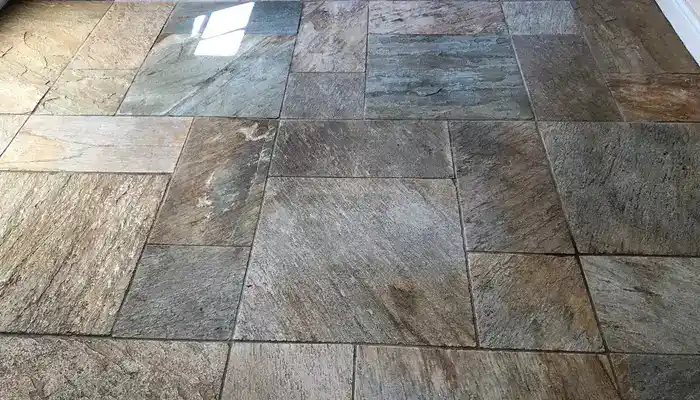
Even a clean slate can appear unsatisfactory when aiming for an even, rich colour. New installations may lack adequate protective layers or may have been treated with unsuitable surface finishes, preventing the floor from exhibiting its full depth until outdated residues and poor coatings are effectively addressed.
A loss of colour does not necessarily indicate dirt accumulation. Instead, colour fading suggests that the surface has worn down due to foot traffic, stripping the pigment away rather than dirt that can easily be cleaned off. Persistent scrubbing may only highlight the lighter areas; the first step in remedying this is to eliminate contamination, stop further abrasion, and restore appropriate protection where feasible.
Fading occurs due to pigment loss, traffic abrasion, and surface wear, leading to diminished visual richness. Homeowners may notice washed-out patches, a dull finish, and reduced colour in frequently used pathways. Addressing this issue involves first removing contamination and then restoring suitable protection where possible.
Powdery surface residue consists of loose or degraded material remaining after wear, coating breakdown, or repeated inadequate cleaning. Homeowners may observe a dull finish, powder formation, residue build-up, and challenges in cleaning. Professional intervention entails removing surface contamination and reinstating a stable finish before regular maintenance can resume.
Sealer failure occurs when the protective layer can no longer regulate absorption, drying, or soil release. Homeowners may note water soaking in, a patchy appearance, rapid re-soiling, or colour inconsistency. Professional correction requires removing the failed surface film and applying appropriate protection only after the tile has been cleaned and dried.
Micro-scratching refers to fine surface damage caused by grit, abrasive pads, or harsh scrubbing. Homeowners may perceive a grey, flat, or hazy surface when light strikes it. Correcting this necessitates stopping the abrasion and restoring the appropriate protective finish instead of resorting to stronger cleaners.
Routine cleaning should protect slate by eliminating loose grit before wet mopping, managing moisture, and preventing detergent residue. Correct ongoing maintenance — pH-neutral cleaning, grit removal before wet mopping, and resealing at appropriate intervals — is vital for prolonging the floor’s lifespan.
Steam cleaning should be approached with caution and not regarded as a quick fix. The potential for heat damage, sealer breakdown, moisture penetration, surface peeling, coating degradation, and loss of protective layers might jeopardise the floor’s stability, particularly if a surface film already appears worn.
Different areas in a household impose varying demands on slate, such as kitchens, hallways, boot rooms, and entrances to historic properties. Hard water can leave unsightly spots and chalky white marks, while garden grit in rural homes can accelerate surface wear before homeowners notice a significant problem.
A clean slate floor should not be evaluated solely on whether the mop water appears dirty. A more reliable measure is whether the surface dries evenly, feels free of sticky film, maintains consistent colour, and remains cleaner for longer after the soil has been removed.
How Do Variations in Slate Sources Influence Cleaning Results?
If one slate floor dries evenly while another remains patchy following the same cleaning method, the tiles may not behave as identical materials. Variations in slate sources impact cleaning behaviour since slate is not a uniform, predictable surface. Welsh slate typically exhibits high density and hardness with low porosity, while Indian slate tends to be softer and more porous, making it more vulnerable to absorption challenges.
Surface texture significantly affects cleaning effectiveness. Natural cleavage and mechanically split surfaces retain soil differently. A smoother floor may release dirty water quickly, while a more unevenly textured surface can retain moisture and residue in low areas, even when identical cleaning products and methods are applied.
Slate from China can demonstrate inconsistent quality, making it essential to test and match sealers accurately rather than assuming one cleaning product will work for all slate floors. This variability explains why two slate floors can undergo the same maintenance routine yet present differing colours, depths, and definitions after drying.
What Causes Subsurface Marks and Dull Patches in Slate Flooring?
Marks beneath the visible surface necessitate careful evaluation before resorting to harsher cleaning methods. A patch may indicate trapped residues, coating build-up, fading colour, or early delamination rather than merely dirt resting on the tile.
Sealer build-up can encase fine soil within topical excess, edge build-up, recessed areas, and application residues. Homeowners may notice uneven finishes or a floor that appears dirty after cleaning. Correction involves removing the interfering layer before assessing the tile’s true condition.
Not every dull patch signifies dirt that needs scrubbing away.
Delamination occurs when layers separate due to foliation failure along weak mineral planes. Homeowners may witness flaking, loss of lamination, or weakened surfaces. Correction requires stabilising the affected area without forcing additional water, cleaner, or abrasion into it.
How Does the Surface Finish Impact Safe Cleaning Techniques for Slate Floors?
Using inappropriate tools on unsuitable slate finishes can exacerbate the floor’s appearance, even with careful cleaning efforts. A fine-honed slate floor features a smooth, uniform surface that diffuses light evenly, while an impregnating sealer preserves the natural riven texture, and a topical sealer adds a low surface sheen.
<a href=”https://fabritec.org/sandstone-cleaning-simplified-for-effortless-care/”>If the finish is smoother</a>, managing water, cleaner dilution, and residue removal becomes less challenging since the mop head contacts the surface more uniformly. This does not render the floor immune to detergent residue but reduces the likelihood of dirty rinse water settling in recessed areas.
If the finish is more uneven, the riven texture poses a greater cleaning challenge as moisture and soil can remain trapped within the textured surface. Cleaning methods tailored to the finish will significantly enhance the floor’s appearance, and a professionally restored and correctly sealed floor is much easier to clean and maintain than one that is worn or improperly treated.
Why Does Soil Accumulate More on Uneven Slate Compared to Smooth Floors?
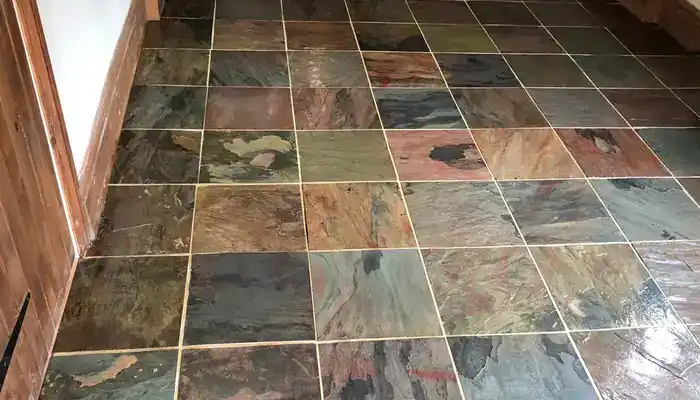
If the high points of your slate appear cleaner than the lower textured areas, it indicates that the floor is trapping soil within its uneven surface. Uneven slate provides dust, fine grit, and dirty mop water more opportunities to settle compared to a smoother surface. The raised areas may initially look clean, while the lower textures still harbour cloudy water, soap residue, and ingrained dirt.
The riven texture functions like shallow relief rather than a flat surface. During professional cleaning, a carbon brush, polypropylene brush, or stiff nylon detail brush can reach deep grooves, while a flat mop often skims over elevated points, leaving soiled residue behind.
Slurry extraction is crucial to prevent loosened contaminants from drying back into the riven surface. A wet vacuum provides effective contamination control by immediately removing dirty solutions, ensuring that residues are eliminated before the floor dries and regains its dull appearance.
How Can Regular Mopping Lead to a Dull Finish on Slate Floors?
Repeated mopping can render slate dull if the water lifts soil but fails to remove it entirely from the surface. Using a well-wrung mop, a wringer bucket, warm water, and clean rinse water minimises over-wetting and prevents cloudy water from spreading across porous slate.
Neutralising alkalinity after deep cleaning is vital since an alkaline cleaner may leave residues if dilution, dwell time, and thorough rinsing are not managed properly. A mildly acidic solution or neutralising cleaning agent can be used professionally to eliminate alkaline residues, maintain sealer effectiveness, and prepare the floor for safe drying.
For routine cleaning, opting for a pH-neutral stone cleaner is advisable, as it promotes pH balance, supports regular maintenance, and ensures a residue-free surface. The practical cleaning and sealing context is detailed in this slate cleaning and sealing guide, emphasising the principle of removal over mere wetting.
How Does Sealer Build-Up Give the Illusion of a Dirty Slate Floor?
If your slate appears dirty after washing, the issue may not be loose soil on the surface but rather old protective layers lingering over the tile. Sealer build-up can trap fine soil and detract from the slate’s appearance, making it look dirty even after cleaning. Coating build-up, edge accumulation, topical excess, recessed areas, and application residues can interfere with drying and create uneven finishes.
Old surface films may obscure clean tiles underneath while still presenting a grey or patchy appearance on top. Professional treatments for build-up involve solvent action, acrylic removal, wax dissolution, chemical penetration, coating stripping, and sealer removal — these are not routine home cleaning measures.
Colour-enhancing protection affects appearance only after the surface has been cleaned, residue-free, and dried. Concepts like mineral activation, colour enhancement, pigment deepening, visual richness, and breathable barriers are explored in this wet-look slate explanation, linking appearance to appropriate protection rather than merely dirt removal.
How Do Common Cleaning Mistakes Gradually Alter Slate Colour and Surface Integrity?
Cleaning mistakes can accumulate over time, causing changes to the floor before homeowners recognise a problem. Over-wetting, steam cleaning, harsh cleaners, residue build-up, and repeated abrasion can all impact colour, texture, and definition without leading to immediate visible failure.
What Is the Effect of Steam and Heat on Slate Floors?
Steam-induced sealer failure occurs when heat softens or disrupts a protective layer, forcing moisture into the surface. Homeowners may notice surface peeling, risks of flaking, coating degradation, and instability of the surface. Correction begins with discontinuing steam use and assessing the failed layer.
How Do Aggressive Cleaners and Residue Impact Slate Quality?
The use of harsh cleaners can result in colour changes, sealant stripping, and permanent damage. Products designed for cement residue or limescale should not be assumed to work as general slate cleaners, as mineral deposit treatment necessitates testing, neutralisation control, rinsing discipline, and a dry microfibre finish.
What Are the Consequences of Abrasion and Dirty Water on Slate?
Loose grit and repeated scrubbing can gradually diminish surface definition over time. A nylon detail brush can effectively eliminate loose salt or white film in a controlled manner, but abrasive pads and dirty water left in grout joints can lead to dulling, detergent traces, and recurring rinsing issues.
How Does an Effective Maintenance Routine Enhance the Cleanliness of Slate Floors?
If your slate looks impressive for a day or two after cleaning but loses its shine rapidly, it is time to refine your maintenance routine. Effective moisture control, correct cleaner dilution, thorough residue removal, grit management, and drying practices determine whether the floor remains clear between cleans.
- Vacuum using a soft brush before wet mopping to prevent loose grit from abrading high-traffic areas.
- Employ a well-wrung mop head, warm water, and a clean bucket to avoid over-wetting the floor.
- Change rinse water before it becomes cloudy, as dirty water can redeposit soil into the texture and grout.
- Utilise a finish-safe cleaner at the appropriate dilution rate, then dry thoroughly with a soft cloth in areas prone to water spots.
Proper maintenance diminishes premature dullness by managing moisture and preventing residue from becoming a maintenance challenge. Avoid steam cleaning, as heat damage and moisture penetration can compromise the protective layer, while diligent daily cleaning helps the floor stay cleaner for longer.
When Should You Consider Professional Help for Your Slate Floor?
If safe cleaning techniques no longer enhance the floor’s appearance, the issue may have escalated beyond what standard home maintenance can resolve. Failed coatings, embedded residues, surface breakdown, and damage necessitate evaluation since mopping alone can merely redistribute existing contamination.
- Water absorbs quickly, darkens the tile, or fails to bead in high-traffic areas.
- Old coatings exhibit a patchy, yellowed, sticky, or darker appearance around the edges.
- White chalky dust, mineral salts, haze, or surface deposits reappear after rinsing and drying.
- Flaking surfaces, peeling layers, lamination loss, or weakened areas become visible after moisture stress.
Professional restoration is essential when cleaning cannot separate soil from failed finishes or structural changes. The floor will show significant improvement after intervention, provided that the surface can be stabilised, cleaned, and protected without further harm.
What Actions Should You Take When Cleaning, Sealing, or Addressing Damage on Slate Floors?
If your slate continues to look dull, patchy, faded, or unstable after safe cleaning, the next steps will depend on the visible issues present. The appropriate course of action hinges on whether the problem relates to cleaning failures, old coatings, steam damage, colour loss, or surface deterioration. A floor with detergent residue build-up requires different treatment than one with layer separation, moisture entrapment, grout haze, or protective sealant failure.
Cleaning failures typically signal a need for residue removal, controlled moisture, and safer routine maintenance. Old coatings and sealer build-up necessitate assessment of the coatings, while colour loss and fading should be regarded as pigment loss, visual degradation, and surface wear rather than merely dirt.
For a comprehensive understanding of slate behaviour, damage boundaries, and related guidance, refer to this broader overview of slate floors in UK homes. This resource ensures that this page remains focused on cleaning results while addressing deeper topics such as sealing, deterioration, and long-term care.

David Allen — Abbey Floor Care
David Allen has over 30 years of experience working with slate floors across the UK through Abbey Floor Care. His practical knowledge of material behaviour, restoration sequencing, and long-term floor care informs every article published under the Abbey Floor Care name.
This article How To Clean Slate Floors? When They Stay Dull was first found on https://www.abbeyfloorcare.co.uk
The Article Cleaning Slate Floors: Revive Dull Surfaces Easily appeared first on https://fabritec.org
The Article Revive Dull Slate Floors with Easy Cleaning Tips Was Found On https://limitsofstrategy.com
The Article Easy Cleaning Tips to Revive Dull Slate Floors found first on https://electroquench.com