This comprehensive guide is specifically designed for Sydney residents who often find themselves examining the small fabric care tag discreetly hidden beneath their lounge cushions. Many ponder the significance of the letter displayed on this tag before reaching for a cleaning cloth. At Wundaguard, we frequently receive inquiries regarding this matter, especially after someone has attempted to remove a stain, inadvertently worsening the situation.
The single letter on that tag conveys essential information about the most suitable cleaning methods for your fabric. Using an incorrect technique can turn a minor blemish into a permanent eyesore.
Quick Overview: The letter represents the manufacturer’s cleaning code. A W indicates that water-based cleaners are suitable, S denotes that only solvent-based cleaners should be used (no water), W-S signifies that either type of cleaner is acceptable, while X indicates that only vacuuming is allowed — no water or solvent can be used, necessitating professional cleaning instead.
Applying plain water to S or X fabrics can lead to irreversible watermarks.
Let’s delve into the meaning of each code and discuss the importance of exercising caution with S and X tags.
How to Find Your Fabric Cleaning Code
Quick Overview: Check beneath a seat cushion, on the back of the lounge, or on the tag stitched into a seam near the base.
Most lounges sold in Australia feature a small white care tag that displays a single letter code. Begin by lifting a seat cushion to inspect the underside, as this is the most common location for the tag. If it is not located there, check inside the cushion zipper, on the back panel, or near the frame. If the tag remains elusive, it is wise to assume the fabric has an S or X code (the more cautious approach) until you can ascertain its cleaning requirements.
Understanding Each Fabric Cleaning Code
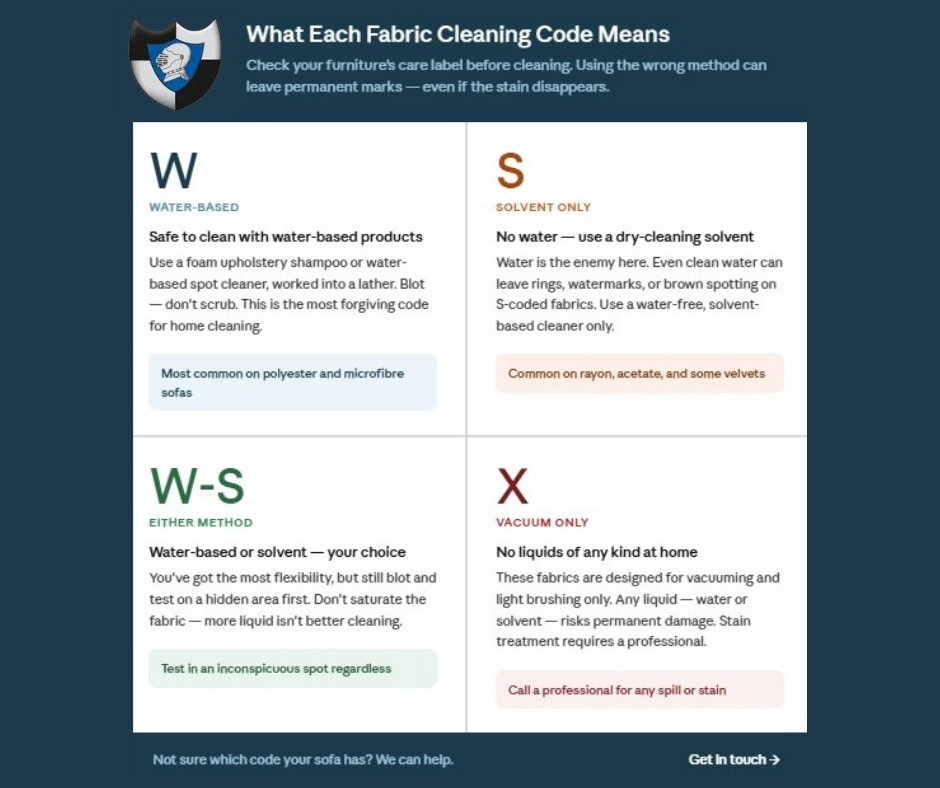
Quick Overview: W = water-based, S = solvent only, W-S = either type of cleaner, and X = vacuum only.
- W (water-based): This code permits safe cleaning with a water-based product, such as a foam cleaner or upholstery shampoo that has been lathered. It is the most forgiving code for careful spot cleaning at home.
- S (solvent only): Only a water-free, solvent-based (dry) cleaner is appropriate. Using water can cause damage, leading to rings, watermarks, and brown spots, even if the original stain appears to have been removed.
- W-S (or S-W): Both water-based and solvent-based cleaners are acceptable. This option offers the most flexibility, but always blot and conduct a test instead of soaking the fabric.
- X (vacuum only): No water or solvent is allowed. These fabrics must only be vacuumed or lightly brushed. Any liquid cleaning should be managed by a professional.
Identifying the Risks Linked to S and X Codes
Quick Overview: Many instinctively reach for water and a cloth, which can often lead to permanent marks on S or X fabrics.
In the event of an accident, the natural instinct is to grab a damp cloth. This method typically works for W fabrics, but it can be detrimental to S or X fabrics. Water can spread dyes and old residues to the edges of the wet area, creating a dried ring or can interact with the fibres, resulting in a brown halo. This issue is particularly common with velvets, linens, viscose blends, and many modern designer fabrics, which tend to be classified as S or X more frequently than the durable materials from previous decades.
This common mistake illustrates the challenges of DIY spot cleaning — the attempted solution often causes more damage than the initial spill.
Crucial Steps to Take Before Cleaning Your Fabric
Quick Overview: Always check the cleaning code, blot instead of rubbing, and test any cleaning product on a hidden area first.
Step 1 — Find the tag and comprehend the code. If it indicates S or X, avoid using water.
Step 2 — Blot the spill immediately with a clean, dry, light-coloured cloth. Press, lift, and repeat. Rubbing is a mistake — it can push the spill deeper into the fabric and flatten the fibres.
Step 3 — If the code permits a cleaner, test it first on a hidden area (such as the back corner or under a cushion) and wait for it to dry before treating visible areas.
Step 4 — If gentle blotting does not lift the stain, stop further attempts. Additional efforts often result in setting the stain further. At this stage, seeking professional advice is advisable.
For guidance on whether your lounge should be cleaned with water or solvent, refer to our comprehensive guide on whether sofas should be steam cleaned or dry cleaned. This guide details our decision-making process for various fabric types.
When to Consider Hiring a Professional Cleaning Service
Quick Overview: Any S or X fabric, any stubborn stain, and delicate materials such as velvet or linen should be entrusted to a professional to prevent permanent damage.
Since 1983, we have been providing this essential service. An X-coded lounge cannot be cleaned with water at home, and an S-coded lounge requires the appropriate solvent and technique, not just any supermarket cleaner. We utilise methods that align with the cleaning code and fibre type, conduct tests before treatment, and carefully control moisture to ensure the fabric dries evenly without unsightly rings.
This is why several leading furniture retailers — including Freedom, Lounges Plus, and Strictly Comfort — recommend our services for addressing marks after delivery and for ongoing maintenance. They trust us to clean and protect their showroom stock. If delicate fabric deserves meticulous care for showroom presentation, it certainly warrants the same attention in your home. Explore our complete range on our furniture cleaning page, with fabric protection starting from $44 per seat.
Frequently Asked Questions About Fabric Cleaning
What does the S tag on my couch represent?
An S tag signifies that only solvent-based cleaning is permitted. This fabric should only be treated with a water-free, solvent-based (dry) product, and water must never be used. Applying water to S-coded fabric can result in rings, watermarks, or brown spots, even after the original stain seems to have disappeared. For anything beyond a light, tested spot clean, it is advisable to leave S fabric cleaning to the professionals.
Is it safe to use water on an X-coded lounge?
No. An X code strictly indicates vacuum only — neither water nor solvent is permitted at home. These fabrics are intended to be vacuumed or lightly brushed, with any liquid cleaning reserved for professional services that utilise appropriate low-moisture methods. Using water on X fabric is one of the primary causes of permanent damage to a quality lounge.
What distinguishes the W and W-S cleaning codes?
W indicates that only water-based cleaners are suitable for use. W-S (which may also be referred to as S-W) means either water-based or solvent-based cleaners can be safely utilised. W-S provides greater flexibility, but always remember to blot instead of soak and test any product on a concealed area first.
What should I do if my lounge lacks a cleaning tag?
If you cannot locate a code on the cushions, seams, or back panel, treat the fabric as if it has an S or X code to err on the side of caution — vacuum and dry-blot only, avoiding water. Many designer and imported fabrics can be sensitive to water, so misjudging the cleaning method can be costly. If you’re uncertain, send us a photo or call us before applying any cleaning method.
What is the cost of professional upholstery cleaning in Sydney?
Costs vary based on fabric type, lounge size, and its condition. The best approach is to request a quick quote instead of making assumptions. Our fabric protection services start from $44 per seat, and we will provide a clear cleaning price after assessing your lounge’s specific needs. Call us at 1300 360 824 for a straightforward quote tailored to your lounge.
Vital Insights for Effective Fabric Care
The code on the fabric tag is crucial — it can be the difference between maintaining a pristine lounge and encountering a permanent stain. Always check the letter, remember to blot instead of rub, and for S or X fabrics, leave wet cleaning to the professionals. If you have any questions, share a photo or contact us at 1300 360 824 — we are happy to assist you in identifying your fabric, even if you do not choose to book a service.
Original Article First Published At: Understanding the W, S, W-S, and X Tags on Your Lounge
The Article: Understanding W, S, W-S, and X Tags on Your Lounge first appeared on https://writebuff.com
The Article W, S, W-S, and X Tags Explained for Your Lounge Was Found On https://limitsofstrategy.com
The Article W, S, W-S, and X Tags: A Guide for Your Lounge found first on https://electroquench.com