Essential Techniques for Effective Restoration of Porcelain Floors in London Homes
- Porcelain's natural resistance to dirt absorption ensures that issues like dullness and haze are typically caused by surface films, mineral deposits, or contaminants trapped within cementitious grout, rather than defects in the tiles themselves.
- Floors that appear clean when wet but seem dull after drying are often affected by detergent residue build-up, grout haze, or high Total Dissolved Solids (TDS) present in London water, creating a microscopic layer on the tile surface.
- Textured and riven porcelain can darken in high-traffic areas as dirt becomes mechanically trapped within the surface profile, which regular mopping fails to address effectively.
- For professional restoration, a combination of deep chemical–mechanical cleaning and proper slurry extraction is essential; relying on harsh DIY scrubbing, steam cleaning, or bleach treatments can exacerbate underlying issues.
- Cleaning has its limits: chipped tiles, deep scratches, bleach-damaged grout, and loss of factory gloss may necessitate grout recolouring, burnishing, or tile replacement, which can only be accurately determined through an onsite assessment.
Understanding the Causes of Dull, Hazy, or Perpetually Dirty Porcelain Floors
The appeal of porcelain flooring in London homes lies in its exceptional durability and water resistance. Many homeowners presume that basic maintenance will keep their floors in pristine condition. However, when tiles begin to exhibit a dull, hazy, or consistently dirty appearance, they often find themselves regretting their choice. This dissatisfaction can stem from a lack of understanding regarding the specific care required to maintain the aesthetic appeal of porcelain.
Expert Tips for Daily Maintenance of Porcelain Tile Floors
|
Fila Pro Floor Cleaner
|
LTP Porcelain Floor Tile Cleaner
|
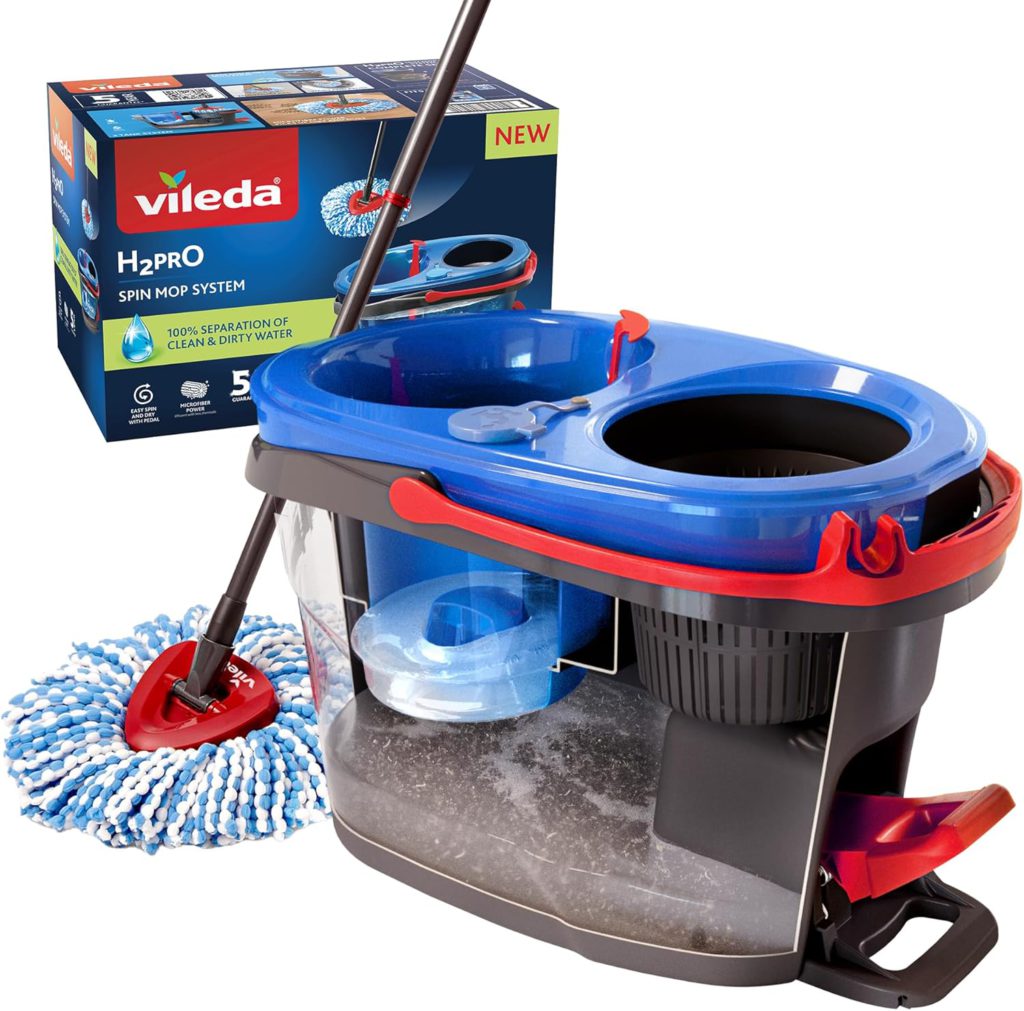
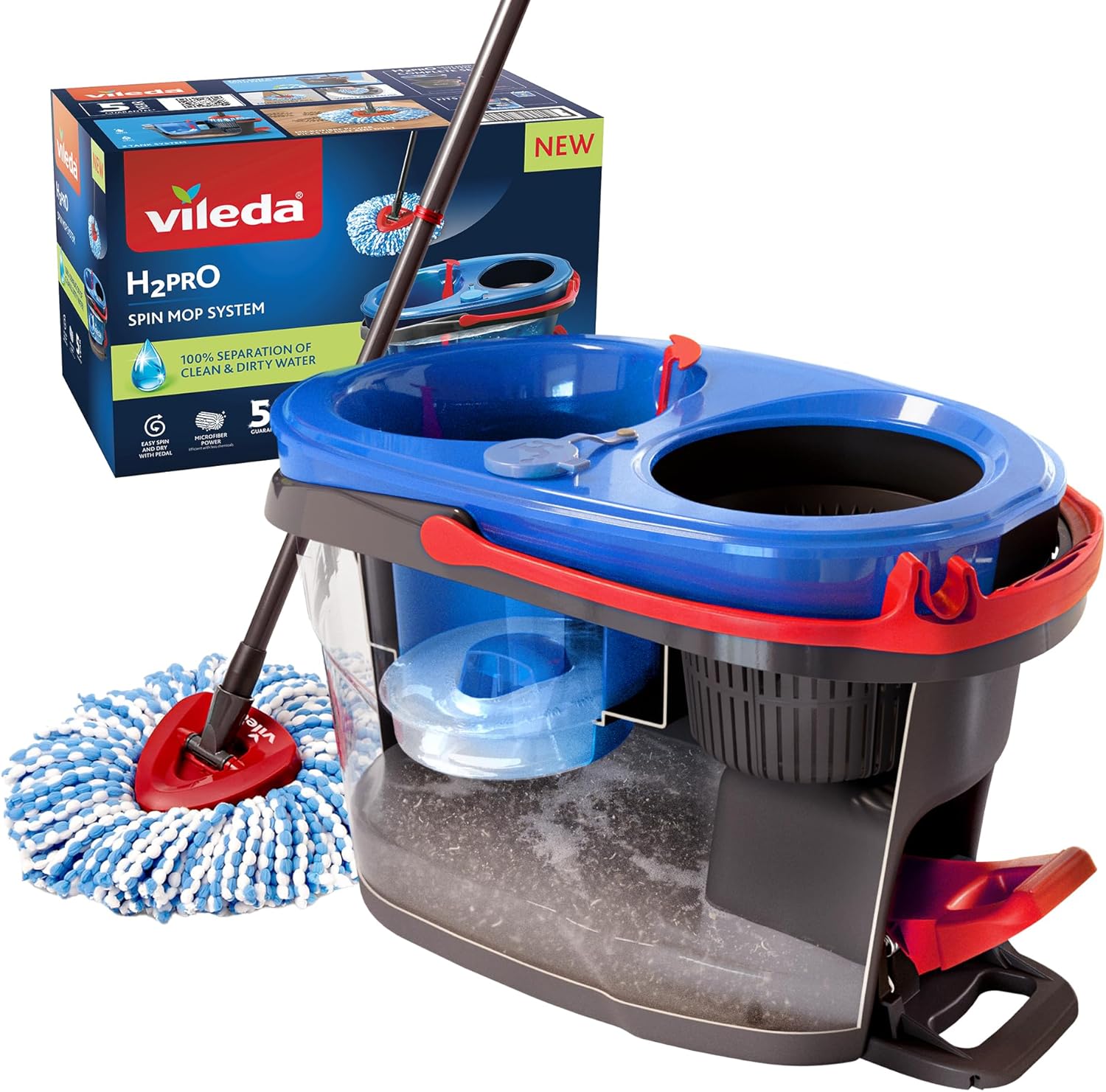
Vileda H2PrO Spin Mop System
|
In most cases, the source of frustration lies at the surface level. With porcelain, many challenges arise either on the surface or within the grout, rather than deep within the tile itself. Understanding this can empower homeowners to adopt better maintenance practices that will prevent the recurrence of dullness and haze.
What Homeowners Typically Notice First About Their Floors?
There are specific signs that often lead homeowners to feel that “something is wrong” with their flooring:
- The floor appears cloudy, even after mopping
- Streaks or light patches emerge as it dries
- Textured areas look darker in high-traffic paths
- The grout lines appear dirty or uneven despite scrubbing, and polished areas lose their clarity, looking worn.
It is common for the floor to appear more attractive when wet, only to disappoint once dry. This observation usually signals the presence of surface films, mineral deposits, or residue rather than simply “dirt that won't disappear.” Recognising these signs can help homeowners take appropriate action to maintain their porcelain floors.
Why Do Porcelain Floors Exhibit Surface Problems?
Porcelain is a highly vitrified material with impressive resistance to absorption. This unique characteristic alters the behaviour of dirt. Instead of soaking into the tile, contaminants tend to remain on the surface or accumulate within the cementitious grout lines. This is why some porcelain floors may appear worse over time, despite regular cleaning efforts.
While the tile itself is resistant to damage, the grout is porous and susceptible to staining, and textured surfaces can trap dirt. This duality often complicates cleaning and maintenance, necessitating a more strategic approach to preservation.
A professional typically begins not with a heavy-duty cleaner, but by assessing the specific surface conditions present:
- Grout haze and leftover installation debris
- Detergent residue build-up that forms a film attracting further soil
- Dirt compacted into the texture, especially in traffic lanes
- Limescale and other mineral films in areas with hard water
Once these factors are accurately diagnosed, the action plan becomes clearer: remove surface contaminants, address grout appearance when necessary, and apply refinement techniques only when the tile finish will benefit from it.
Understanding the Impact of London Water on Floor Haze
One of the most frequently overlooked challenges for homeowners in London is the unique composition of the city’s water supply. Sourced from chalk aquifers, London water undergoes extensive treatment and recycling before reaching your taps, resulting in a remarkably high Total Dissolved Solids (TDS) count.
When mopping with standard tap water, moisture evaporates, leaving behind residual minerals and by-products from treatment. In a high-calcium area such as the Thames Valley, this creates a microscopic “mineral veil” over the porcelain. Over time, with routine cleaning, these minerals bond with detergent residues, forming a sticky, dull film that standard mopping cannot eliminate. This explains why a floor may seem clean while wet but quickly returns to a hazy, streaky finish as the London water dries.
Identifying the Common Causes of Dull or Patchy Porcelain Floors
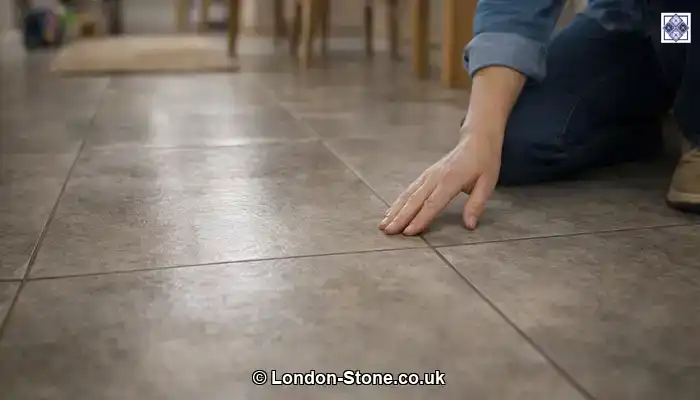
When a porcelain floor displays a patchy appearance, it is easy to assume it is “worn out.” However, this is often misleading. In most situations, the dullness results from something adhering to the surface or trapped within the texture. Understanding this distinction is vital for effective maintenance.
Homeowners often worry about damaging the tiles during cleaning, and this concern is valid, especially if various products have been attempted without success. A professional cleaning strategy is designed to effectively remove contaminants without resorting to harsh scrubbing that could cause unnecessary damage to the tiles.
Grout Haze and Residue from Installation
Grout haze remains one of the most prevalent causes of porcelain appearing dull. Fine residues left after grouting can dry as a thin film over the surface. Although this haze may not be immediately visible, it scatters light and detracts from the tile's overall finish, creating an impression of dirtiness.
This issue is surface-related and can give the false impression that the tiles are “permanently dirty,” as standard washing does not eradicate it. The correct approach involves a controlled cleaning process to eliminate mineral residues, followed by thorough extraction to prevent them from settling back as the floor dries.
Surface Films and Residue Build-Up from Cleaning Agents
Another common cause of dullness is residue build-up from everyday cleaning agents. Many detergents leave behind a film that traps soil, creating a cycle of repeated cleaning without achieving the desired results. The porcelain itself is not at fault; rather, the cleaning routine creates a surface condition that simple mopping cannot correct. Restoration requires breaking down the film, completely removing it, and disposing of the slurry instead of redistributing it.
Dirt Trapped in Traffic Lanes on Textured Tiles
Textured or riven porcelain behaves differently from smoother finishes. The texture increases the surface area, providing more locations for dirt to collect. In busy households, dirt accumulates in traffic lanes, creating the impression that the tiles are stained or permanently darkened.
This issue usually arises from mechanical trapping rather than absorption into the porcelain itself. This is why mops and microfibre cloths often fail to clean effectively: they clean the raised surfaces while the recessed areas retain dirt. A specialised approach uses controlled agitation to penetrate the texture, followed by slurry extraction to prevent lifted soil from settling back into the grooves.
Limescale and Mineral Deposits in Wet Areas
Hard water can lead to limescale and other mineral deposits forming on porcelain surfaces. These deposits can manifest as dull patches, streaks, or a hazy layer that seems to reappear quickly. They also alter the drying process, making marks more noticeable.
Similar to haze and films, this problem primarily affects the surface. Removing mineral deposits requires a different strategy compared to dealing with grease or general soiling. This distinction is crucial as it prevents unnecessary abrasion and expedites the cleaning process.
Setting Realistic Expectations: What Cleaning Can Achieve and What It Cannot
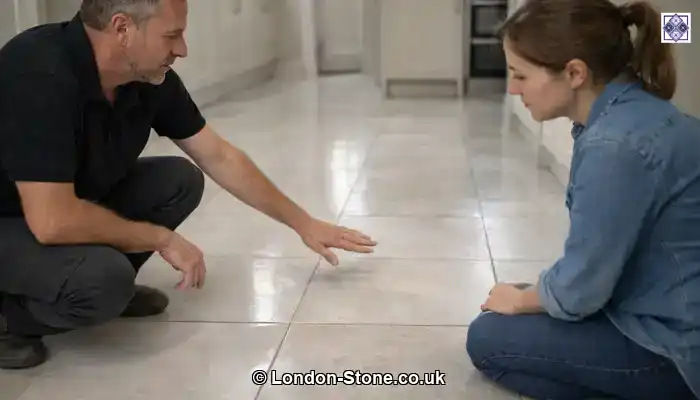
It is crucial to clarify what “restoration” entails in the context of porcelain. The primary aim is typically to restore clarity and achieve a more uniform appearance, rather than to physically alter the material itself. Porcelain does not behave like stone, and the safest methods take these properties into account.
Being transparent about limitations is essential for conducting the job correctly. Homeowners should be informed about what can be improved through cleaning and refinement, and what will not change without repair work. This understanding fosters realistic expectations and guides decisions regarding future maintenance.
When Deep Extraction is the Solution
Deep chemical–mechanical cleaning is employed when the issue involves bonded contamination, such as haze, films, ingrained dirt in textured surfaces, and heavy soiling within grout lines. The principle is straightforward:
- Specialised chemistry loosens the contamination based on its nature (organic soil versus mineral residue)
- Mechanical agitation effectively reaches the texture and grout
- Slurry extraction removes lifted contaminants, ensuring they cannot settle back
When performed correctly, homeowners typically notice a clearer surface, reduced patchiness, and a more uniform appearance between tiles and grout. Textured floors often benefit the most, as soil is removed from within the surface profile rather than merely being displaced.
Understanding Limits Around Chipped Tiles, Scratches, and Factory Gloss
Cleaning cannot rectify physical damage. If a tile is chipped or cracked, the issue is one of repair, not cleaning. The same holds true for deep scratches. A cleaner surface may make damage more visible, but it will not eliminate it.
With polished porcelain, the final appearance relies on the factory finish. Burnishing can enhance clarity and minimise light scuffing, but if the micro-finish has been physically altered, it may be impossible to replicate the original gloss. This is why outcomes must remain condition-dependent, ensuring that expectations align with achievable results.
Why Bleached Grout Requires Grout Recolouring
Bleach-damaged grout is a common occurrence that can lead to significant visual issues. Grout is porous and more susceptible to chemical damage than porcelain. Once grout has been lightened or washed out, cleaning cannot restore its original colour.
This is where grout recolouring becomes a practical solution. It allows for controlled changes in the grout's appearance and can yield a more uniform result than repeated cleaning. In certain circumstances, replacement may be the only option, but recolouring frequently serves as the cleaner method to restore a consistent finish without the need for disruptive grout removal.
What Professionals Observe On-Site for Safe Assessment
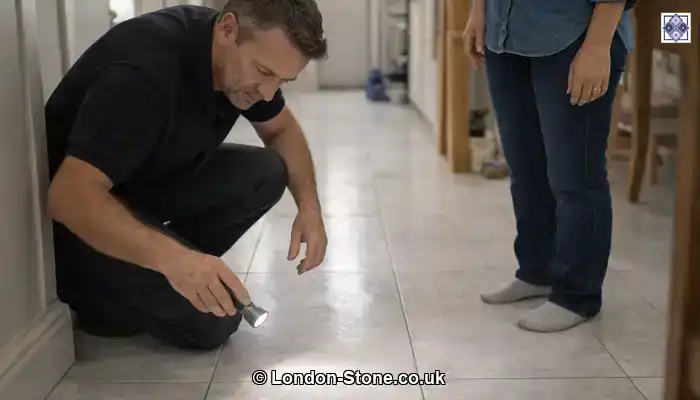
Homeowners often seek quick, definitive answers: “Is this grout haze?” or “Have I ruined the tiles?” A professional cannot guarantee answers remotely, nor should they pretend to do so. Instead, they can explain what they look for when assessing the floor and why those observations are crucial to achieving the desired results.
Evaluating Tile Finish, Texture, and Previous Coatings
The tile's finish and texture significantly influence how it becomes dirty and how it can be cleaned safely. Textured/riven porcelain can retain soil within its profile, while polished porcelain may gradually lose clarity and become more prone to displaying marks. Micro-porous porcelain behaves differently, as it may accept specific protective treatments that fully vitrified porcelain will not.
A specialist also examines whether coatings or residues on the surface do not align with the tile's finish. This includes identifying incorrect sealer residue, where a product has dried as a film instead of providing effective protection.
Assessing Grout Condition and Colour Variation
Grout frequently contributes to the “dirty floor” sensation. Because cementitious grout is porous, it absorbs soil quickly and stains more easily. It can also be damaged by aggressive cleaning methods, resulting in patchiness or permanent colour changes.
A specialist will evaluate whether the grout colour shifts in certain areas, whether the same paths quickly become dirty again, and whether the grout surface appears to have been treated with harsh chemicals. These observations help determine if deep cleaning is sufficient or if grout recolouring is a more viable option.
Indicators Suggesting Professional Treatment is Necessary
Several recurring patterns often indicate that professional cleaning is the sensible next step:
- A haze or dull layer that doesn’t respond to routine cleaning
- Texture that remains dark in the traffic lanes, regardless of how frequently it is washed
- Grout lines that appear uneven, discoloured, or consistently re-soil
- Evidence of detergent residue build-up or mineral deposits reappearing after drying
These indicators are not diagnostic tests, nor are they remote assessments. They are practical signals that suggest the issue is likely bonded to the surface and necessitates controlled removal rather than more of the same routine cleaning.
Factors That Subtly Exacerbate Problems with Porcelain Floors
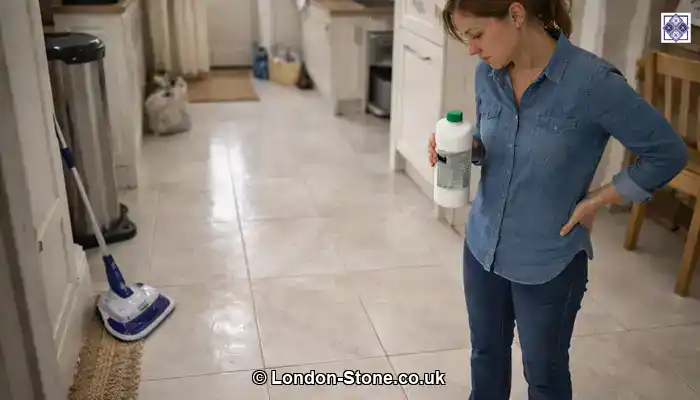
When porcelain appears dirty, it is instinctive to clean more vigorously or resort to stronger products. However, porcelain floors often face predictable issues not due to the tiles' inherent weakness but because grout and surface conditions do not respond well to improper treatment.
A significant aspect of restoration is to prevent avoidable damage. This approach protects the existing finish and prevents a removable-surface issue from escalating into a repair problem that requires more extensive intervention.
Issues with Steam, Bleach, and Aggressive Detergents
Steam cleaning, bleach, and harsh detergents can create long-lasting complications without addressing the root cause. Steam may force moisture and contaminants deeper into the grout lines, while bleach can discolour grout and leave it patchy. Strong detergents can contribute to residue build-up, leaving surface films that attract soil and quickly make the floor appear dull again.
These methods often encourage excessive scrubbing, increasing the risk of physical wear and complicating future professional cleaning efforts.
The Impact of Applying Sealers to Non-Porous Porcelain
Most porcelain does not require sealing. Fully vitrified porcelain typically does not absorb sealers effectively, meaning they can dry as a film on the surface. This film becomes a residual sealer, necessitating specialist removal.
There are exceptions, such as micro-porous porcelain and certain textured finishes that may need sealing on a case-by-case basis. The critical takeaway is that sealing is not universally beneficial; it must be tailored to specific surface behaviour to maximise effectiveness.
Risks of DIY Scrubbing Leading to Edge Chipping
Heavy scrubbing with abrasive pads and tools can cause physical damage, particularly at tile edges and grout lines. Edge chipping is a common outcome when homeowners employ aggressive removal methods, including DIY grout cleaning.
Once edges are chipped, cleaning cannot reverse the damage. At that point, the realistic solution shifts toward repair, which may involve replacing tiles if matching tiles can be found. Understanding the risks associated with DIY cleaning is essential for preserving the integrity of porcelain floors.
How Professionals Safely Restore Clarity to Porcelain Floors
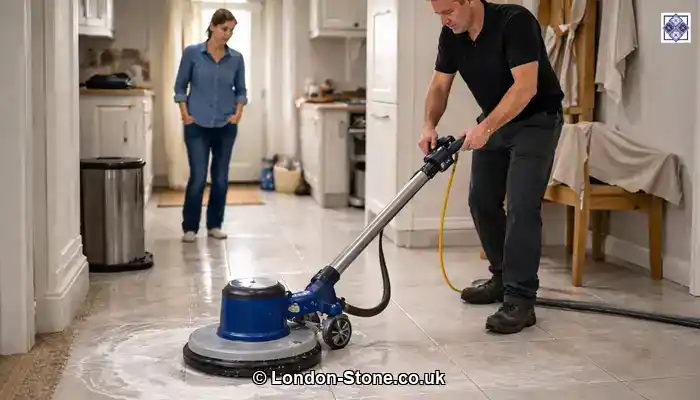
The objective is not to force a finish but to align the method with the tile finish and the type of contamination, ensuring complete removal without compromising the tile material.
This controlled approach also alleviates a common concern: that professional services will scratch the tiles. When the process is tailored to the behaviour of porcelain and grout, the focus is on lifting soil and residue without causing abrasion, leading to consistent and satisfactory results.
Chemical–Mechanical Cleaning and Slurry Removal Techniques
The cornerstone of professional porcelain cleaning is deep chemical–mechanical cleaning, complemented by slurry extraction. The rationale is material-specific:
- Porcelain resists absorption, so the goal is to address surface-bound contamination effectively
- Grout is porous, necessitating controlled cleaning that does not further degrade it
- Textured surfaces require agitation that penetrates the profile for thorough cleaning
- Extraction ensures lifted contaminants cannot settle back into the surface, maintaining cleanliness
The chemistry used is tailored to the type of contamination to be removed. Organic soil and grease react differently from mineral residues and haze. Keeping these approaches distinct enables effective cleaning without unnecessary risk of damage.
Refining Polished Porcelain through Burnishing (When Appropriate)
Burnishing serves as a refinement step for polished porcelain. It can enhance clarity and uniformity on surfaces that have dulled over time or show light scuffing.
This process differs from stone honing; it does not rely on significant material removal. The aim is to refine the existing surface and improve light reflection while acknowledging that factory gloss cannot always be perfectly replicated if the micro-finish has been physically altered.
Grout Repair and Grout Recolouring Options
As grout is often the weakest link in a flooring system, addressing grout issues can significantly enhance overall aesthetics. Deep cleaning may improve grout condition, but it cannot reverse bleach-damaged grout where the colour has been irreversibly lightened.
Grout recolouring is frequently the most effective way to restore a consistent appearance without the disruption of full grout removal. This process restores the grout’s appearance and can be combined with appropriate protective measures, depending on the grout's condition and the floor's usage.
Setting Realistic Expectations and Understanding Cleaning Limits
The restoration of porcelain typically results in noticeable improvement, but it is not an unrestricted solution. The best outcomes depend on the type of finish, existing residues, grout condition, and the products previously used on the floor.
Clearly defined limits protect homeowners from investing in inappropriate services. They also prevent the pursuit of more effective cleaning methods when the core issue may require repair or grout renovation, ensuring that the restoration process is efficient and effective.
Why Consistent Results Cannot Always Be Guaranteed
Uniformity is influenced by factors that may not always be correctable. Variations in installation quality, tile batches, grout application, and historical cleaning practices can lead to inconsistencies across a floor.
Professional services can enhance clarity and coherence, but they cannot assure that every tile and grout line will match perfectly if inherent discrepancies exist. Understanding this can help homeowners manage their expectations realistically.
When Tile Replacement Becomes the Only Realistic Option
If a tile is chipped, cracked, or otherwise physically damaged beyond cosmetic repair, cleaning will not resolve the issue. The practical course of action is tile replacement, contingent upon having matching spares and the ability to remove and re-fit tiles without causing additional damage.
This is particularly crucial in homes with underfloor heating, as removal must be performed carefully. A specialist should treat tile replacement as a distinct repair decision, rather than part of the “cleaning” process.
What Can Only Be Confirmed Following an On-Site Assessment
There is no remote guarantee feasible. The tile finish, the type and thickness of residues, the presence of any incorrect sealer residue, the condition of the cementitious grout, and the extent of trapped contamination all influence the outcome of any restoration efforts.
A specialist can outline likely processes and realistic limitations, but confirmation requires an on-site evaluation of the surface and grout behaviour under professional cleaning conditions. This ensures that homeowners receive tailored advice that addresses their specific circumstances.
Maintaining the Appearance of Porcelain After Restoration
Once the surface has been thoroughly cleaned and extracted, routine maintenance becomes more manageable. The key is to avoid recreating the same film conditions that initially caused the floor to appear dull.
Most long-term disappointments stem from the return of surface films, rather than a failure of the porcelain itself. Maintenance focuses on keeping the surface clean without leaving residue that could compromise the aesthetic appeal of the floor.
Correct Utilisation of a Neutral Cleaner
A neutral cleaner aids in routine cleaning without damaging grout or leaving aggressive residues. It also mitigates the risk of gradual grout degradation, which may later manifest as patchiness or uneven colour. Understanding the right cleaning products is essential for preserving the quality of porcelain floors.
The aim is consistency and moderation: eliminate daily soil, rinse away what has been lifted, and avoid cleaners that leave behind a film that can contribute to future issues.
Practices That Minimise Surface Films
Simple practices can help reduce the likelihood of build-up returning:
- Avoid routine use of detergents that leave a sheen or fragrance film
- Refrain from overdosing on cleaning products, as this can lead to residue accumulation
- Avoid relying on repeated “quick cleans” that merely redistribute residue without removing it
By minimising surface films, the floor maintains clarity, while textured areas are less prone to darkening in traffic lanes. This proactive approach supports the longevity and appearance of porcelain floors.
When to Seek a Case-By-Case Assessment
If haze returns rapidly, textured tiles retain soil after routine care, or polished areas continue to lose clarity, it is wise to request a case-by-case assessment. This is especially pertinent if grout appears patchy, bleached, or consistently re-soils.
Early evaluation is often simpler than repeated attempts at stronger DIY cleaning, as it reduces the risk of turning a removable-surface condition into edge chipping, grout damage, or improper sealer residue. Seeking professional advice can save time and prevent further complications.
Next Steps for Homeowners in London Facing Porcelain Floor Challenges
If any of these issues resonate with you, we can conduct an assessment of your floor and clarify what is realistic before you commit to any work. Understanding your options is the first step towards restoring the beauty of your porcelain floors.
Frequently Asked Questions About Porcelain Floor Restoration
Do porcelain tiles actually wear out, or is the dullness attributed to something else?
In domestic settings, porcelain tiles themselves seldom wear out. When a floor appears dull, hazy, or patchy, the cause is typically surface-bound residue, which may include detergent build-up, grout haze, mineral deposits from London water, or dirt trapped in textured finishes. In most cases, the integrity of the tile body remains intact, making proper maintenance crucial.
Why does my porcelain floor seem clean when wet but dull again once it dries?
This phenomenon often indicates the presence of surface films or mineral residue. When water evaporates, dissolved minerals and cleaning residues remain, forming a microscopic veil that scatters light. In homes across London, the high mineral content of tap water amplifies this effect, making it essential to consider the quality of water used for cleaning.
Is sealing of porcelain floors necessary after professional cleaning?
Most fully vitrified porcelain tiles do not require sealing and do not effectively absorb sealers. Applying a sealer unnecessarily can leave a surface film that detracts from the floor's appearance. Some micro-porous or heavily textured porcelain may benefit from targeted treatment, but this should only be determined following an on-site assessment by a qualified professional.
The Article Porcelain Floor Restoration for London Homes: A Practical Guide was first found on https://london-stone.co.uk
The Article Porcelain Floor Restoration: Essential Guide for London Homes appeared first on https://fabritec.org
The Article Porcelain Floor Restoration Guide for Homes in London Was Found On https://limitsofstrategy.com